
How The US Republican Economy Could Affect UK Tech Businesses

Earlier this month we all watched America elect Donald Trump President of the United States, and although the UK is busy with its own new government, it is clear that changing economic policies in the US will have ripple effects all the way across the pond.
As the tide turns on the American presidency many of Joe Biden’s economic policies are now at risk of being reversed, with the interests of Silicon Valley being perhaps unprecedentedly aligned with the Republican agenda. Trump’s laissez-faire approach to business regulatory bodies, along with the tariffs on imports he has already started to use as a bargaining chip in his foreign policy, are spreading mixed feelings through the global economy.
In this analysis we’ll focus specifically on the impact of the Republican party’s most likely economic policies on the British tech-led and innovative sectors, and in particular how the funding environment for UK startups will be affected by each policy.
Deregulation, Investment, and the IPO Market
This is the main area of interest for many high-profile Trump supporters from Silicon Valley, Elon Musk first and foremost. While he’s certainly been one of the most vocal about it, Musk is far from being the only Big Tech leader to support the Republican party in this election. As per The Verge, some of the most prominent Venture Capitalists in Silicon Valley have expressed their support for the policies in the Republican Manifesto, including Sequoia Capital, 8VC and—most notably—Marc Andreessen and Ben Horowitz from a16z.
What Silicon Valley investors and CEOs—who have historically supported the Democratic party—really want from the Trump administration is deregulation, which Andreessen and Horowitz believe would foster innovation, and would make for much friendlier compliance requirements for sectors like AI and crypto. Mitigated regulatory risks for emerging tech might put US investors in a more bullish mood, inflating otherwise sluggish valuations.
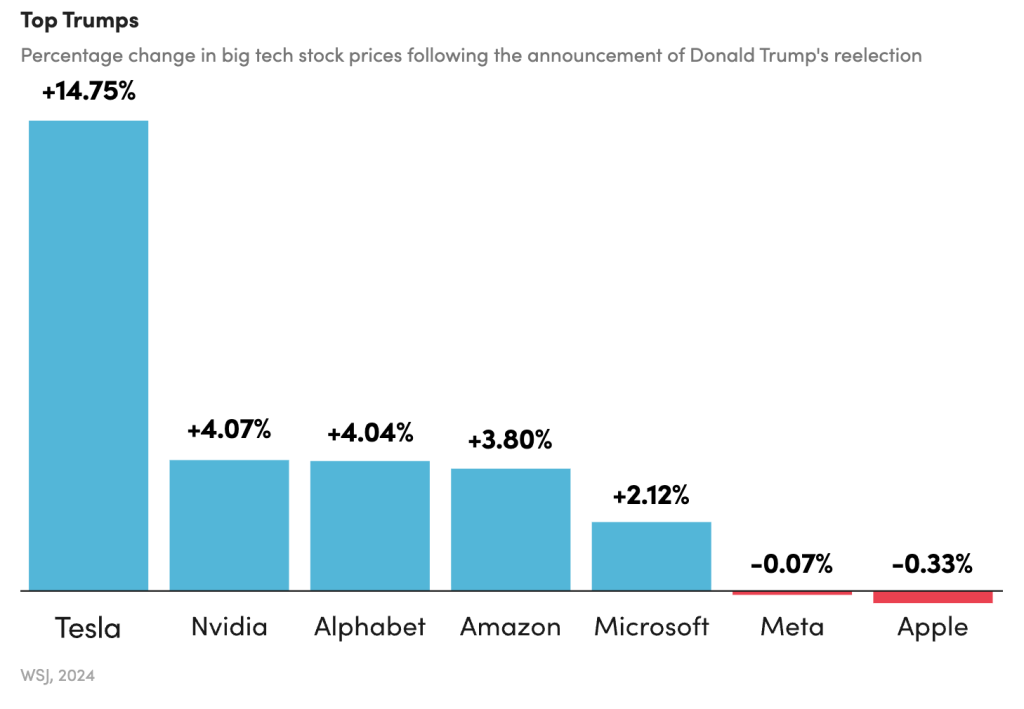
The Republican focus on deregulation could breathe new life into the US IPO market, making it more attractive for UK tech firms seeking access to American capital markets. If so, reduced regulatory hurdles, particularly in the tech and finance sectors, may create a more favourable environment for startups aiming to go public in the US, often considered a gateway for global tech companies to scale their operations. This could mean, however, more near misses for the London Stock Exchange, rumoured to be the top choice for Swedish $15bn company Klarna, which ended up listing in the US instead.
The Impact of Tariffs on Global Trade
A hallmark of Trump’s first administration was the imposition of tariffs on Chinese goods, and a renewed Republican government will certainly use these both in practice and as a political deterrent, not only with China but—as per Trump’s agenda—with all foreign imports. As the US is UK’s main trade partner, purchasing 14% of UK’s total exports, this would deal a significant blow to industries that rely heavily on the US market such as the pharmaceutical sector and the Scottish whisky industry.
Most importantly, such policies could disrupt global supply chains, significantly impacting UK tech firms reliant on imported components for manufacturing. Higher costs of goods could lead to delayed production cycles or reduced profitability.
Winning & Losing Sectors
It’s no secret that the Republican party has been a big promoter of the crypto sector throughout the presidential campaign. Trump has headlined crypto events and vowed to fire Gary Gensler, chair of the Securities and Exchange Commission who has cracked down on many crypto businesses under the Democrats. The appointment of Elon Musk to lead the newly created Department of Government efficiency also bodes well for the EV sector, as well as AI.
Semiconductors are also a big part of the Republican agenda, with Trump criticising Biden’s CHIPS & Science Act—which establishes incentives for chipmakers to manufacture on US soil—although it looks unlikely that he will actually try and revert it.
The Republican campaign’s emphasis on technological dominance and safeguarding against international threats seems to indicate that these sectors will thrive under the upcoming government. UK companies in these areas could benefit as demand for cross-border collaboration and solutions grows.
Conversely, companies operating in sectors heavily reliant on global collaboration—such as green technology—may face challenges as Republican policies deprioritise international agreements or funding for sustainable initiatives.
Inflation & Devaluing the Dollar
A potential shift in US monetary policy, with a focus on tax cuts, reduced rates thanks to the upcoming appointment of the Federal Reserve chair, and increased government spending, could lead to inflationary pressures. A weaker dollar, resulting from inflation or other macroeconomic shifts, may make US markets less lucrative for UK tech exports, as the exchange rate reduces their competitiveness.
On the other hand, UK tech firms importing US-based services could benefit from a weaker dollar, as their operational costs in the US become cheaper. Understanding these dual dynamics will be critical for UK companies navigating this economic environment.
Ultimately, like most things, a Republican-led US economy offers both opportunities and challenges for UK tech businesses. Deregulation and heightened investment in sectors like AI and cybersecurity are likely to provide growth avenues, while the impact of tariffs, potential trade barriers, and a weaker dollar will certainly require strategic adjustments.
In the meantime, to ensure that the UK remains a competitive place for tech entrepreneurs to start, run and grow a business, the British Government must pay close attention to the shifts in the US tech market.
The information available on this page is of a general nature and is not intended to provide specific advice to any individuals or entities. We work hard to ensure this information is accurate at the time of publishing, although there is no guarantee that such information is accurate at the time you read this. We recommend individuals and companies seek professional advice on their circumstances and matters.
-

Health & Wellness: 2026 Valuation Multiples
9 May 2026
In Q1 2026 the median EV/Revenue multiple for Wellness & Health companies was 1.1x, only slightly under pre-pandemic levels.
Report : Tech, Trends and Valuation
-
Green Energy & Renewables: 2026 Valuation Multiples
6 April 2026
The outbreak of war in Iran and the broader Middle East in early 2026 has radically altered the global energy landscape, providing an unexpected boost to green energy valuations.
Report : Tech, Trends and Valuation
-
Beauhurst 2025 Funding Review: A Return to Form for Early-Stage Founders
3 February 2026
After years of decline, the number of UK companies securing their first funding round rose by 23.6% in 2025, reaching a total of 2,489.
Report : Fundraising, Investment and Trends




Sign up for the Founder's Bulletin
Join our community of 4,000 + Founders, Entrepreneurs & Advisors. Refreshingly simple financial insights to help your business soar.
