
Is AI Monopolising Venture Capital Funding?

While innovation can be driven from any corner of the start-up ecosystem, a healthy inflow of VC money into each sector has long been necessary to transform nascent ideas into market realities. While in the past couple of years a majority of startups experienced a funding shortage, mostly due to macroeconomic factors, the AI sector seems to be immune to any external market forces.
With Artificial Intelligence’s rapid advances and widespread applications, from generative models like ChatGPT to autonomous driving and healthcare diagnostics, investors have been funnelling unprecedented amounts of capital into the sector. This momentum has resulted in a disproportionate amount of VC funding being allocated to AI-related ventures, which begs the question: is this concentration monopolising VC funding at the expense of innovation in other sectors?
How Much Money Are VCs Funnelling Into AI?
The numbers tell a compelling story. Data from Crunchbase shows that AI startup funding more than doubled in Q2 2024 compared to the previous quarter, up 50% year on year, as reported by Reuters. According to PitchBook, AI companies received nearly $40 billion in venture capital in 2023, accounting for a significant portion of the total global VC investment—over 27% if we only look at the US market.
Perhaps an even more interesting finding from Pitchbook data shows how the median time window from one funding round to the next has been increasing from about 15 months to over 19 over the past 8 quarters.

Unfortunately we could not find any data specific to AI (or exclusively non-AI) start-ups, but considering the relentless news cycle about AI companies raising finance at record valuations, it’s easy to imagine that the sector is causing a squeeze of funding opportunities for other start-ups, which are now forced to extend their runways, which as we know is the leading cause of failure for start-ups.
Even when they are not forced to shut down, start-ups that are struggling to raise money they’ll have to settle for more investor-friendly term sheets or raise at a lower valuation. “There’s a real allergy to down-rounds in Silicon Valley, Lloyd Danzig, managing partner at Sharp Alpha Advisors, told Pitchbook.
Is The AI Gold Rush A Good Or A Bad Thing?
Of course, there is only so much money to go around, and if AI is the next big thing then it’s natural that investors want to buy into that. We’ve seen this with many emerging technologies, including blockchain and crypto, VR and metaverse and more.
Sadly, funding frenzies like these can result in bubbles. Not all AI companies can be winners, and some are already struggling to ensure that their financial results meet the stellar valuations at which they raised funding. Critics of the sector argue that VCs chasing after the next AI unicorn might neglect essential sectors like clean energy, education technology, or biotech, which are equally crucial to societal advancement. This “AI first, everything else later” mentality could dampen innovation in areas that traditionally have longer development cycles or require more time to produce viable returns.
Some, however, argue that this seemingly absolute dominance of AI over all other sectors of innovation is more of a byproduct of media coverage and the massive megadeals that dwarf your average funding round—like Elon Musk’s xAI $6bn Series B.
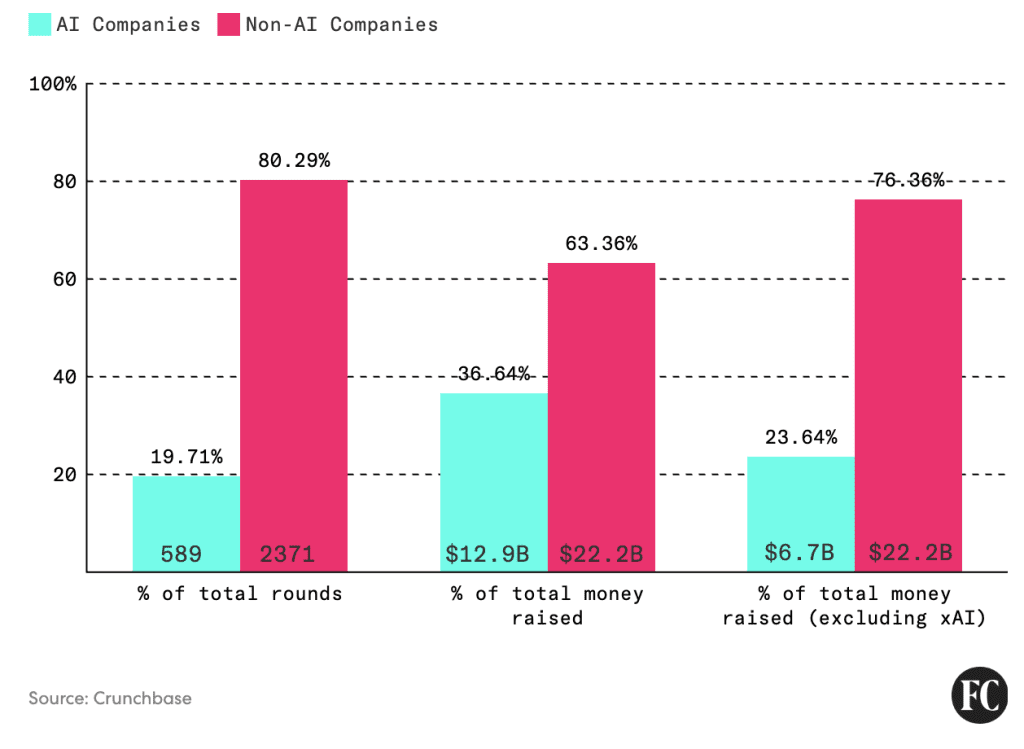
A Fast Company report argues that, excluding such exorbitant megadeals, AI companies are raising a similar amount of funding per-round as their non-AI counterpart. Still, 20% of all US Funding Rounds between May and July went to AI companies, which hardly matches the proportion of AI companies in the whole start-up landscape.
Yet, AI proponents argue that the heavy flow of capital into AI is not a zero-sum game but rather a necessary investment in the future. Artificial Intelligence applications can be leveraged to create efficiencies, improve productivity, and address global challenges like climate change and healthcare disparities.
Additionally, many argue that AI’s current monopoly on VC funding could lay the foundation for startups in other sectors to benefit from AI-driven innovations down the line, according to a EY report.
Sink Or Swim?
Whether this AI gold rush ends up being good or bad for the start-up ecosystem and society as a whole, will ultimately come down to its performance and market impact.
If the AI sector delivers on its promises, it could create a new wave of economic growth and technological breakthroughs. However, if the sector fails to live up to the immense expectations, we might see a rapid reallocation of capital to more traditional and diversified industries.
How long the AI gold rush will continue—and whether it’s bubble is going to pop or simply cause the broader market to readjust—is currently anyone’s guess. It’s important to mention that policymakers and regulatory bodies are yet to play a pivotal role, like they did for blockchain, in this still largely unregulated sector.
The information available on this page is of a general nature and is not intended to provide specific advice to any individuals or entities. We work hard to ensure this information is accurate at the time of publishing, although there is no guarantee that such information is accurate at the time you read this. We recommend individuals and companies seek professional advice on their circumstances and matters.
-

Health & Wellness: 2026 Valuation Multiples
9 May 2026
In Q1 2026 the median EV/Revenue multiple for Wellness & Health companies was 1.1x, only slightly under pre-pandemic levels.
Report : Tech, Trends and Valuation
-
Green Energy & Renewables: 2026 Valuation Multiples
6 April 2026
The outbreak of war in Iran and the broader Middle East in early 2026 has radically altered the global energy landscape, providing an unexpected boost to green energy valuations.
Report : Tech, Trends and Valuation
-
Beauhurst 2025 Funding Review: A Return to Form for Early-Stage Founders
3 February 2026
After years of decline, the number of UK companies securing their first funding round rose by 23.6% in 2025, reaching a total of 2,489.
Report : Fundraising, Investment and Trends



Sign up for the Founder's Bulletin
Join our community of 4,000 + Founders, Entrepreneurs & Advisors. Refreshingly simple financial insights to help your business soar.
