
AI Won’t Fix Your Practice, Lean Operations Will

by Adam Brodie – Finerva Founder, RouseFinerva Partner
I have been running Finerva for over a decade: a tech-forward accountancy practice working with the UK’s most innovative companies, many in the AI space. So, naturally, for the past few years I have been fascinated with AI’s promises for our own sector: automation without strict criteria and long setups, productivity without effort, structure without discipline.
Now, just as the AI trend enters the “Trough of Disillusionment” of the Gartner Hype Cycle, I realise that the reality for accountancy practices is more nuanced and far more promising.
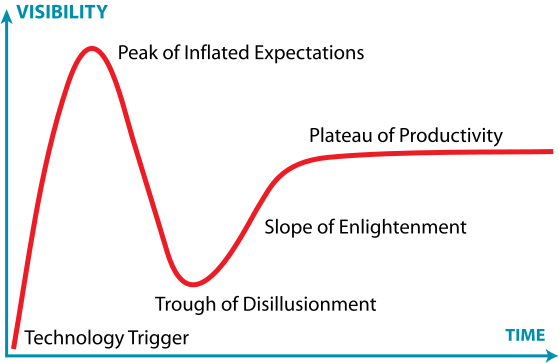
Modern AI systems represent a genuine opportunity to modernise operations, reduce repetitive work, and improve client service, but only when deployed as part of a rigorous, well-governed practice with strong foundations in data quality, processes, and professional oversight. Used carelessly, these tools risk undermining accuracy, client trust, and regulatory compliance.
While vast amounts of capital have flowed into anything labelled “AI,” businesses are discovering that the cost of AI infrastructure often outweighs the benefits. Like all technological advancements, AI creates both opportunity and risk, especially for regulated sectors dealing with sensitive data like accountancy. The solution is not rejecting AI, but deploying technology—some of it AI-powered—where it delivers genuine value while protecting core professional principles.
What accountancy practices can learn from Lean Operations
The Lean Operations doctrine was popularised by Toyota in the 1970s, as AI entered its first winter, but Finerva CTO Stu Coates argues that “accountancy practices have far more to learn from it than from any of the recent tech trends.”
Lean Operations principles are simple: eliminate waste, reduce variation, maximise customer value. A Toyota assembly line has physical parts; in an accountancy practice the raw material is data and documents. Organising information effectively is the necessary condition for any meaningful technological improvement. This requires thoroughly mapped processes, well-designed systems and disciplined execution.
Without these foundations, even the most sophisticated tech stack will fail or produce unreliable outputs. The “Garbage In, Garbage Out” principle remains as true as ever: if you’re sifting through Dropbox folders in search of ACCOUNTS_2026-FINAL3-USETHIS-v2.xlsx, the cloud probably hasn’t made your practice any more lean than it was in the paper-based days.
The best practices combine efficiency with humanity. Technology handles routine tasks; accountants provide judgement, advice, and relationship management.
Eliminating waste through automation
In accounting, the resource more prone to wasting is time. Automation should target repetitive, rule-based tasks where human time consumption can be optimised while accuracy can be maintained or improved.
Strong candidates include invoice and receipt processing, bank reconciliation, standard report generation, as well as routine reminders and document requests.
Automation is not appropriate everywhere. Monthly invoice generation based on accurate data is excellent; automated chasing of late payments from distressed clients is often counterproductive.
Reducing variation through integration
Systems that do not talk to each other create duplicated effort and data inconsistencies. Platforms with strong APIs and open data exchange are leaner choices than proprietary silos. The moment a process requires manual re-keying of data is an opportunity for error and inefficiency.
Tools that aggregate data from multiple sources can identify trends, anomalies, and opportunities far faster than manual review. These systems support better forecasting, benchmarking, and regulatory reporting—provided the underlying data is clean and accurate.
Maximising customer value
Above all, clients value their time, money and peace of mind. That’s why interactions with accountants are often stressful—notifications of tax liabilities rarely bring joy. Some of these interactions can now be transformed.
Traditional onboarding through manual, paper-based AML and KYC processes have been replaced by biometric verification, searchable databases, and Open Banking solutions.
Client portals allow 24/7 access to documents, filing deadlines, and reports. These simple but effective tools reduce email traffic, minimise version control issues, and extend service beyond traditional office hours.
Throughout these processes, AI can assist with drafting notes, summarising documents, or generating correspondence, but outputs must always be reviewed by a qualified professional.
Crucially, strategic advice, important news and tough conversations should always be delivered by a human to a human. Emotional intelligence still matters. Algorithms inform, humans decide.
Risks, governance, and regulatory realities
Every new system introduces new risks—particularly around data security, confidentiality, and professional liability.
The regulatory environment around AI is starting to catch-up, especially in Europe: a German court recently held Google liable for false statements in AI Overviews, moving the responsibility of ensuring accuracy away from the final consumer.
Professional indemnity and cyber insurance policies typically require “all reasonable steps” to mitigate risk: adoption of unvetted tools may jeopardise cover.
As Chartered Accountants, we are required to enforce—at a minimum—the ICAEW guidelines for AI adoption, which include thorough due diligence of any third-party tools, along with strict access controls and least-privilege principles as well as human oversight for all professional judgements. Additionally, inputting any identifiable client data into general purpose AI constitutes a breach not only of your governing body’s professional code, but also of UK data protection law and, most likely, your engagement letter.
A practical roadmap to a future-ready practice
So what does it take for an accounting practice to effectively adopt AI technology?
Finerva CTO Stu Coates came up with a lean four-step roadmap:
- Data – Implement strong data management, integration, and document control.
- Automation – Target high-volume, low-judgement tasks in bookkeeping and compliance.
- Analytics – Unlock insights from consolidated, high-quality data.
- Selective AI – Introduce generative tools and agents for productivity, always with oversight.
Practices that follow this sequence will build genuine competitive advantage by using tools to eliminate waste, improve consistency, and free their people to focus on higher-value work: advising, strategising, and building trust.
Those that jump straight to flashy generative AI without foundations are likely to waste money and increase risk.
Software should help humans, not replace them. Get the foundations right, apply Lean thinking, govern technology responsibly, and the tools of 2026 and beyond can become genuine assets rather than expensive distractions.
The future belongs to the disciplined, not just the enthusiastic.
The information available on this page is of a general nature and is not intended to provide specific advice to any individuals or entities. We work hard to ensure this information is accurate at the time of publishing, although there is no guarantee that such information is accurate at the time you read this. We recommend individuals and companies seek professional advice on their circumstances and matters.
-

Risk Ledger – £2.1m Seed round fundraising
18 March 2022
Risk Ledger was founded in 2018 by Haydn Brooks and Daniel Saul, with a mission to shift the way organisations approach cybersecurity and information management in the supply chain.
: Clients, Fundraising, Success Stories and Tech
-
SenseOn – $20m Series A fundraising
10 December 2021
We interviewed David Atkinson, CEO of SenseOn and asked several questions about his experience with Series A.
: Clients, Fundraising, Success Stories and Tech
-
Will Cowell De Gruchy – Founder & CEO of Infogrid
8 June 2021
Founded in 2018, Infogrid combines the world’s smartest IoT sensors with an AI-powered platform to help turbocharge facilities managers and real estate portfolio owners’ operations.
: Clients, Fundraising and Tech




Sign up for the Founder's Bulletin
Join our community of 4,000 + Founders, Entrepreneurs & Advisors. Refreshingly simple financial insights to help your business soar.
