
The 2025 AWS Outage Reignited The UK’s Tech Sovereignty Debate

Last week got off to a slow start for millions across the UK, as they opened their laptops, phones and work setups to find the services they rely on grinding to a halt or simply vanishing. Major high-street banks like Lloyds and Halifax were inaccessible. Government portals, including HMRC, went dark. Retailers, delivery apps, and workplace tools—from Snapchat to Duolingo—all stopped working.
The cause was not a coordinated cyber attack, but a failure deep within the infrastructure that powers a vast portion of the modern internet: an Amazon Web Services (AWS) outage.
The event, which originated thousands of miles away in a Virginia data centre, has reignited one of the most pressing strategic questions for UK businesses: what is the true cost of our deep dependence on a handful of US tech giants?
A Global Failure From A Single Point
The technical cause of the outage was a Domain Name System (DNS) resolution failure within AWS’s oldest and largest data centre region, US-EAST-1. This single region in Northern Virginia doesn’t just host services; it also manages many of the global control-plane functions for AWS, such as identity management and database lookups.
When it failed, the domino effect was global.
Services and data physically hosted in the UK became inaccessible because the “front door” in Virginia was locked. The scale was immense: Downdetector logged over 1.5 million outage reports only counting the UK.
While we don’t yet have a precise figure for the economic cost involved in a failure like this, we know it’s likely going to be in the billions of pounds for the UK economy alone, based on similar past events like the CrowdStrike incident of 2024.
The Sovereignty and Concentration Debate
The incident immediately triggered a political and strategic firestorm over market concentration and “digital sovereignty.”
In the US, Senator Elizabeth Warren tweeted bluntly, “If a company can break the entire internet, they are too big. Period.”
Here in the UK, the Competition and Markets Authority (CMA) had already found back in August that “certain features of the UK cloud services markets lead to adverse effects on competition”, raising questions about British businesses’ over reliance on tech systems supplied from across the Pond.
These questions become even more existential when it comes to AWS’s public sector clients. Mark Boost, CEO of UK cloud provider Civo and an outspoken advocate for sovereign cloud, called for more responsible decision making when it comes to tech suppiers, asking “why are so many critical UK institutions, from HMRC to major banks, dependent on a data centre on the east coast of the US?”
This sentiment was echoed in Parliament, where Dame Meg Hillier, MP, Chair of the Treasury Committee, formally questioned the government on its deep reliance on AWS for critical national infrastructure.
Nicky Stewart of the Open Cloud Coalition called the outage “a visceral reminder of the risks of over-reliance on two dominant cloud providers.”
While some governments such as Canada, Germany and the EU are making steps towards “Sovereign Cloud” solutions, these are still largely provided by US big-tech and therefore, according to many, “incompatible” with the concept of sovereignty.
Tech Sovereignty vs. Tech Monoculture
However, the conversation about tech sovereignty—albeit perfectly valid—may be misdirected.
Take the 2024 CrowdStrike outage, for example, which has been often quoted in the past few days as a precedent of comparable scale and scope to the AWS one. CrowdStrike is obviously a market leader and a major player in the cybersecurity market, but can’t exactly be called a “tech giant”.
This points to the problem going beyond market dominance, deep into architectural concentration or, as it’s been called, “tech monoculture”.
As Dr. Aybars Tuncdogan, King’s College associate professor, told GeekWire, “It’s like agricultural monoculture — when everything relies on a single strain, one disease can wipe out entire plantations.”
The AWS outage was a failure of a centralised logical component that many global services depend on. This is an architectural design issue, not just a market share problem. One that, according to some, partly shifts the responsibility onto AWS’s customers.
Strategic Considerations for UK Businesses
Mistakes, especially in tech, happen and will always happen. That’s why even world-class companies aim for 99.99% uptime. So sure, many of us were hating on Amazon as we were stuck on one of many loading screens on Monday morning, but that’s not the whole story.
The AWS outage raised a point about architectural resilience on one hand, and one about sovereignty and accountability on the other. While it may be true that the companies affected share some of the responsibility for not having invested in a multi-region-multi-cloud set-up, it is also deeply concerning that public sector services can be interrupted at a moment’s notice due to an overseas supplier’s malfunction, lacking the regulatory power and oversight that local providers would be subject to.
The information available on this page is of a general nature and is not intended to provide specific advice to any individuals or entities. We work hard to ensure this information is accurate at the time of publishing, although there is no guarantee that such information is accurate at the time you read this. We recommend individuals and companies seek professional advice on their circumstances and matters.
-

SaaS Stumbles in 2025: End of an Era, or Just Growing Pains?
23 October 2025
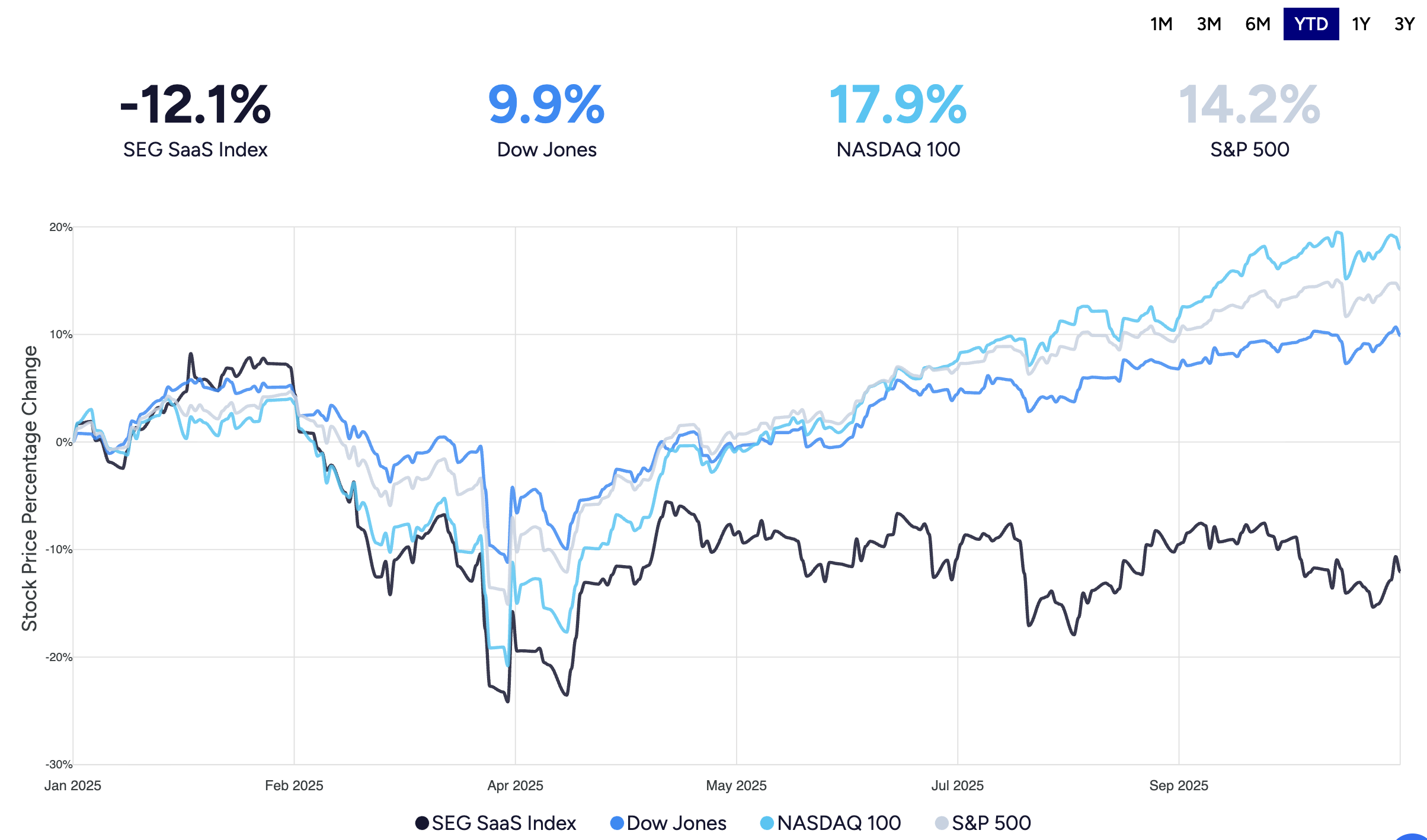
There is a widening gap between SaaS and the rest of the market starting in April 2025, and it’s just getting larger and larger.
Report : Tech and Valuation
-
What The “Tech Prosperity Deal” Means For UK Start-Ups
23 September 2025
Beyond the fancy dinners and royal meets and greets, tech has been one of the main protagonist of Trump’s second presidential visit to the UK.
Report : Opinion and Policy
-
Green Energy & Renewables: 2025 Valuation Multiples
1 May 2025
Trump’s victory dealt the final blow to the Green Energy sector at the end of last year. In Q4 2024 the median EV/Revenue multiple was 5.7x.
Report : Tech, Trends and Valuation



Sign up for the Founder's Bulletin
Join our community of 4,000 + Founders, Entrepreneurs & Advisors. Refreshingly simple financial insights to help your business soar.
