
Is Valuation the most important factor in your Term Sheet?

A term sheet will set out the financial basis upon which the investment is proposed. It’s normally a non-binding offer, subject to due diligence, investment agreement, and often other conditions, such as approval of the investor’s investment committee, possibly EIS or VCT clearance with HMRC also.
There’s often an obsession with valuation in investment rounds, but be careful. Many of the terms should be considered together and as a whole “package”. For example, we have seen founders pushing too hard for a higher valuation and the VC demanding a higher liquidation preference to protect their downside. You should consider taking investment for the same class of shares as the founders and angel investors (often ordinary shares) at a lower valuation vs. taking investment for preference shares at a higher valuation. So, valuation is important, but not the be all and end all.
The key terms to consider are:
- Amount of investment and valuation
- Rights attached to the shares e.g. liquidation preferences
- Anti-dilution provisions
- Employee share option pool
- Control including board representation and investor consents
- Founder leaver provisions
We also spoke to Lizzie Frost, a corporate lawyer at London Law Collective. Read the article Why term sheets are not a one size fits all and find out from an expert on what to expect when drafting your first Term Sheet.
Term Sheet Trends in 2023
HSBC conducted research by surveying 21 UK and international law firms and published a valuable report with data on which this blog is based. You can read the full report here.
Some of the key trends summarised below:
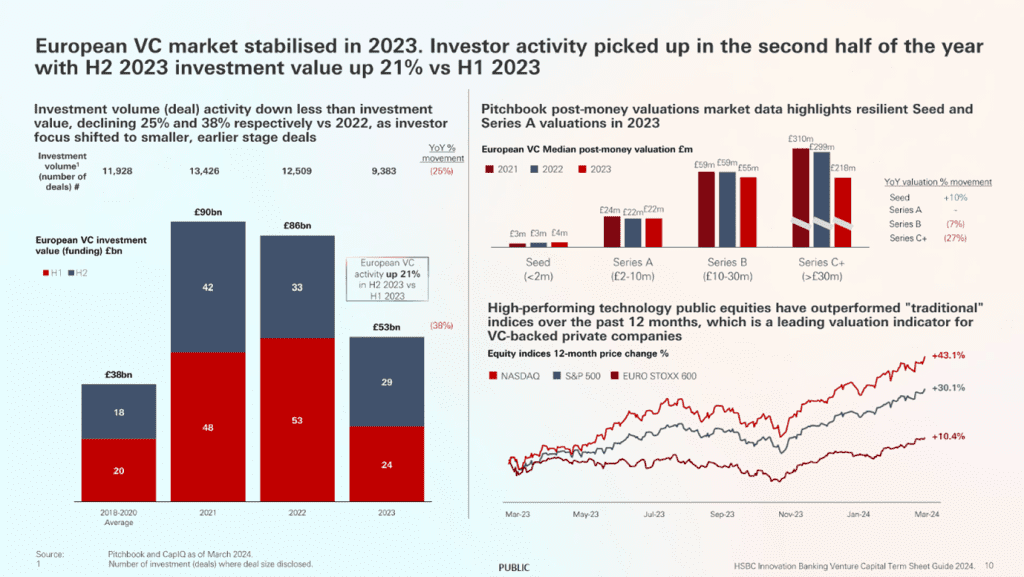
- Seed investment was dominated by UK investors, while later-stage start-ups continued to seek funding from international investors, particularly the US.
- ClimateTech and AI saw the greatest % increase share of total term sheets. Both industries combined, it amounted to 20% – a sharp growth from 9% in 2022.
- Preference shares were identified in 80% of term sheet transactions as the market shift has happened in valuation, not the structure of the investment.
- Deal syndication increased to 42% from 35% in 2022, driven by investors sharing resources and expertise (especially in Series B-C).
- The research also saw a significant up-tick in % and a total number of Term Sheets for Seed investment, representing the resilience of an early stage and also a board representation and anti-dilution decrease as these terms are typically less prevalent at the Seed stage.
Professional support
While a Term Sheet is not a legally binding agreement, it will define the basic terms and conditions of the future investment and will involve a variety of complex legal jargon. In the first instance speak with your accountant to understand the financial terms and impact on your cap table. In some instances, we recommend taking advice from an experienced corporate lawyer.
Get in touch with us regarding any Financial or Tax and our team of experts will support you during this complex process.
The information available on this page is of a general nature and is not intended to provide specific advice to any individuals or entities. We work hard to ensure this information is accurate at the time of publishing, although there is no guarantee that such information is accurate at the time you read this. We recommend individuals and companies seek professional advice on their circumstances and matters.
-

Entrepreneurship in the UK: The “Start, Scale, Stay” Plan Explained
4 December 2025
The plan is built on a simple mantra: backing companies to start, scale, and stay in the UK.
Advice : Policy and Tech
-
SEG’s 2025 Report Reveals SaaS M&A Metrics & Benchmarks
21 February 2025
This report includes metrics and benchmarks that SaaS M&A players on the buy side consider essential for investment and exit opportunities.
Advice : Exit and Trends
-
2025: Five Predictions On This Year’s Trends, Market & Benchmarks
29 January 2025
It’s hard to make predictions that are anything more than slightly educated guesses, but we thought we’d try anyway!
Advice : Fundraising and Trends



Sign up for the Founder's Bulletin
Join our community of 4,000 + Founders, Entrepreneurs & Advisors. Refreshingly simple financial insights to help your business soar.
